The Cocktail of ADHD, Dyslexia and Autism
When we talk about neurodiversity, most people want clean labels. You’re “dyslexic” or you’ve got “ADHD” or maybe someone says you’re “on the spectrum.”
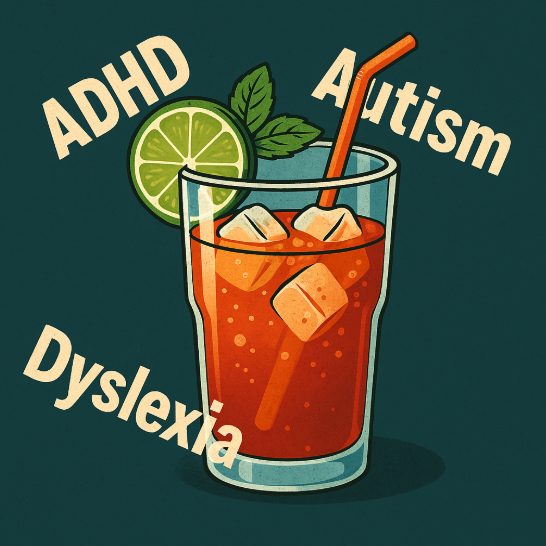
But for so many of us, it’s not one neat label. It’s a cocktail.
For me, dyslexia was the first word that gave my challenges a name. Reading from the board at school was nearly impossible, and that’s what got picked up. But fast-forward 20 years and suddenly I’m sitting in a doctor’s office, learning I also have ADHD. And when I really reflect, I know I carry traits from autism too — a love of routine, moments of social struggle.
This is the truth for so many people: we are not “one thing.” We’re a unique mix of traits, strengths, and challenges. It’s why one-size-fits-all solutions rarely work.
Why it feels like a cocktail
Each piece of neurodiversity adds its own flavour.
- Dyslexia gives us visual thinking, fast pattern recognition, but also the frustration of words not sticking the way they should.
- ADHD brings the kerosene, hyperactivity, dopamine-seeking, the racing energy that can be both gift and chaos.
- Autism traits can add a deep need for structure, a sensitivity to noise or light, or the feeling that social rules are written in a language we never got taught.
- Plus all the rest…
Put them together and you’ve got a cocktail that changes flavour depending on the day. Some days it’s a mojito, sharp, refreshing, full of energy. Other days it’s a hangover in a glass.
The Davis way of looking at it
What I love about the Davis Method is it doesn’t just chase symptoms. It asks: what’s the trigger?
Ron Davis understood that disorientation in the mind’s eye is at the core of dyslexia. That our brains are trying to see 3D meaning in 2D symbols, which leads to confusion. His approach is experiential, clay modelling, visualisation, life concepts. Instead of memorising, you build understanding with your hands and senses.
And here’s the powerful bit: this approach doesn’t stop with dyslexia.
The same life concepts work has helped people with ADHD, autism, dyscalculia, and more. Because at the root, all of these brains struggle with abstract concepts, time, cause and effect, or holding onto focus. Davis methods give those concepts a shape and a place in the mind.
A retrospective shift
Looking back, I wish more of us were told the truth earlier. That dyslexia was never just about spelling. That ADHD wasn’t just about being distracted. That autism wasn’t only about “social skills.”
They’re all connected. They all overlap. They’re different branches of the same neurodiverse tree.
And if we’re honest, so many adults only discover this cocktail later in life. That’s when the grief hits, what could my life have been like if I’d known at 20, not 40?
But awareness also brings possibility.
Why Davis makes a difference
The Davis Method isn’t a quick pill. It’s a way of rewiring how you see the world. For me, doing their Life Concepts course was like having puzzle pieces finally slot into place. Suddenly time made sense. Cause and effect clicked. I wasn’t broken, my brain just needed a different way of learning.
That’s why I believe Davis programs can support across the board, dyslexia, ADHD, autism, dyscalculia, dyspraxia. Because they go to the root. They help us master the building blocks of thought in the way our brains actually work.
And when you shift the foundation, everything else in life gets lighter.
Final thought
So if you see yourself in this cocktail, a bit of ADHD, some dyslexia, maybe a splash of autism, know that you’re not alone. You’re not collecting diagnoses like Pokémon. You’re simply wired differently.And that’s exactly why methods like Davis can make such a massive difference. They don’t try to pour your cocktail into someone else’s glass. They help you understand the mix you already have and use it to build a life that finally makes sense. To learn more about Stephen and his work with dyslexia in adults visit here.